
The Art Cynic
On slugs, clevering, and letting yourself be open.

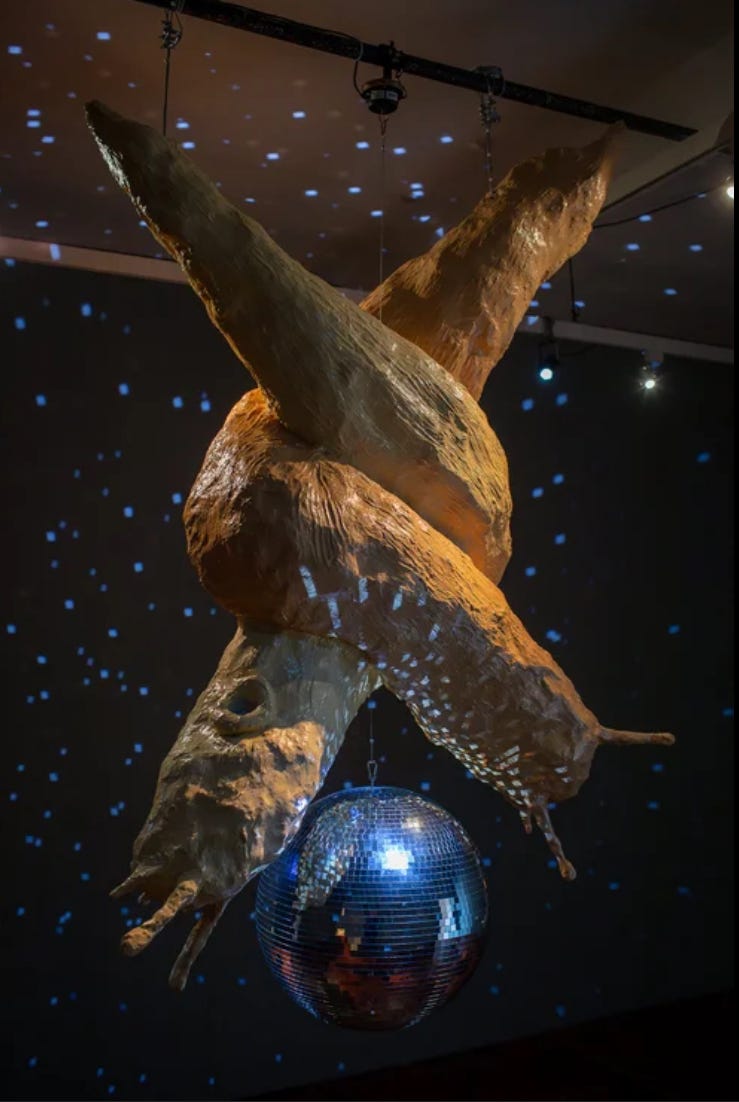
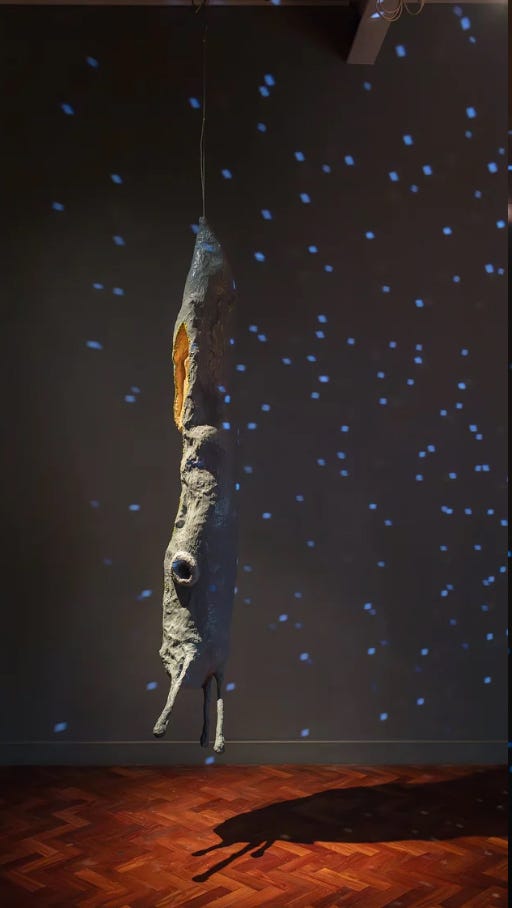
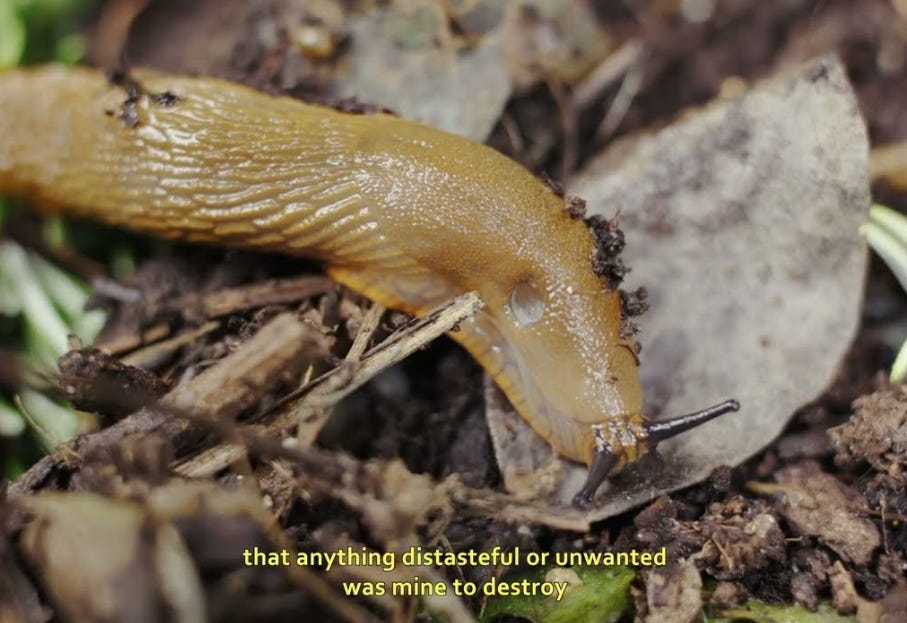
This week I went to see Abi Palmer’s show ‘Slime Mother’ at Site Gallery Sheffield. It’s a wonderful show, and if you are reading this before the 1st of February 2026, you should go. The work explores parallels between the treatment of slugs, and the treatment of queer disabled bodies. There are wall texts, stained glass, film work, audio, an interactive clay wall and a disco ball.
But that’s not what I want to talk about. I want to talk about one guy. A killjoy. A big old square. An Art Cynic. And why I think that’s one of the worst things you could possibly be.
First, I think it’s important to understand that the vibe at that show was wonderful. I spent upwards of an hour in the space, and everyone was having a brilliant time. A group of six or so young women arrived just before me, and let me tell you, they were having the time of their lives. They giggled, they gasped, and engaged with everything enthusiastically.
At one point, one of them sank onto a bench and said, in a reverent voice, “Imagine being able to look at a slug and see all of this.”
Then one of her friends said, “Right? I will never look at a slug the same way again”
In the back of the room behind a curtain were interactive installations, where large sculptural slugs spun suspended from the ceiling, accompanied by the disco ball. There are four curated soundtracks to listen to through headphones. Here, someone was spinning and dancing in an un-selfconscious way. Two people laid together on a floor cushion, watching lights from the disco ball as if they were stargazing.
Enter the Cynic. A man, early 20s at the oldest, sporting a denim jacket and a fluffy moustache he clearly worked very hard to grow. To say the Cynic spent ten minutes in the exhibition would be generous. He whizzed around, mainly muttering to the woman he was with, stopping only to loudly say, “I’m confused.” and, “This is why I don’t like modern art.”
There’s a word which gets used in my family that I have never heard anywhere else. ‘Clevering.’ To be clevering is to be clever in a deliberate or performative way, usually at someone else’s expense. There is a meanness to clevering. It’s a pedantic correction, a ‘well, actually…’: making yourself look smart by making someone else look stupid.
The Art Cynic was clevering.
If I was a different kind of person, I would have stopped him to say, “Um, actually, modern art is very specific work made between 1860 and 1970. This is contemporary art.”
In my early twenties I bought a hat from a vintage shop that I loved. It was a huge, floppy velvet number: purple and black with flowers on the brim. And a friend of mine hated it. She was mortified by the hat, once going so far as to beg me not to wear it when we were together. “People will see us together and think I’m part of this” she’d say.
Underneath all of his clevering, the Art Cynic had a very similar vibe.
If I was a different kind of person, I would have stopped him to say, “The rest of us are having a collective experience engaging with wonder here, but don’t worry. Absolutely nobody thinks you are part of it.”
As someone who has been enthusiastically engaging with contemporary conceptual art since I was a teenager, I’ve met my fair share of Art Cynics. I’ve learnt to tell taxi drivers that I work in admin on days I don’t feel like hearing a stranger tell me how much they HATE modern art. Part of what’s frustrating about these conversations is how original the Cynics think they are being, when really, they all say the exact same things:
Cynic: I HATE modern art
Me: Oh?
Cynic: It’s all crap .
Me: Okay.
Cynic: Yeah, like that Tracey Emin. Rubbish.
Me: Have you ever seen any of her work?
Cynic: No.
Me: Have you ever been to any exhibition of any contemporary artist, or seen any in books, or engaged with art made after 1900 in any way at all?
Cynic: No. Obviously not, why would I when it’s all rubbish.
Let me say here: I don’t mind if you don’t like art. I don’t mind if you never engage with it at all. It’s totally fine if contemporary is just not your thing. I’m never trying to convert anyone to anything. I do, however, think it’s absolute bollocks to say you know you hate everything about something you have never actually encountered. It’s like saying, “I hate all music I have never listened to a single song, but I saw a headline about Lady Gaga’s meat dress one time, and it made me mad. So now I know I hate all music that has ever been made.”
There is another subset of the Art Cynic who I suspect the one at the Slime Mother show belonged to as well. Those who are of the opinion that art was good when Turner or Titian were painting. In the days when Donatello and Michelangelo (and all the other Ninja Turtles) were making proper serious paintings and sculptures. You meet a surprising number of these kinds of people at art school. People who weirdly insist that the vast majority of visual art made in their own lifetime is terrible, but don’t despair, this guy has arrived to single-handedly save the art world by doing paintings of things that look like things.
For these people, the value of an artwork is in the physical evidence of human labour. They don’t necessarily mind if the work is figurative or abstract, but they want to know by looking at it that a person spent years training. They want to know they spent hours on end crouched over an artwork, back aching, hands cramping, and eyes blurring. They want to look at art and feel awed by how hard it was to make, and that’s why “I could have made that” is the biggest insult art cynics can think of.
I think art’s true value is as a tool for communication. That’s what art is. From the oldest cave painting to the current Turner Prize show, art is a conversation. It’s for communicating ideas and feelings too complicated for words. Through art we can have conversations that transcend space and time, with people we’ll never meet. We can have conversations which outlast our own lifetimes.
People dismiss contemporary art because they think it’s unskilled when they can’t see evidence of that physical labour. Contemporary art focuses more heavily on the communication side of things. Good contemporary artists are skilled in the conversations they have with their audience. Good art rewards deep thought from generous viewers. It rewards engagement. Like any conversation, both parties need to put some work in to make it a valuable experience.
Personally, I don’t even think that true artwork is the physical object (or text, or recording, or whatever). I think it’s what happens inside the mind of the viewer when they engage with the work. Really good art is what happens when a stranger has you lying on the floor of an art gallery watching a disco ball like you’re stargazing.
Really good art is a series of internal revelations which permanently alter your relationship to slugs.
And obviously, just like all conversations: not everything works for everyone. You have to have chemistry. You have to click. It’s possible to turn up, be tuned in and ready to do your part of the work…and still feel nothing. That’s the risk.
Still. If I was a different kind of person, I would have stopped the Art Cynic and said, “If you could just try to open yourself up. Just a tiny bit. You might experience something wonderful.”
You can find out more about Abi Palmer’s here: https://www.abipalmer.com/slime-mother
It’s amazing what you can experience and learn if you just open your mind a little
I feel clevering must now enter my lexicon, thank you!